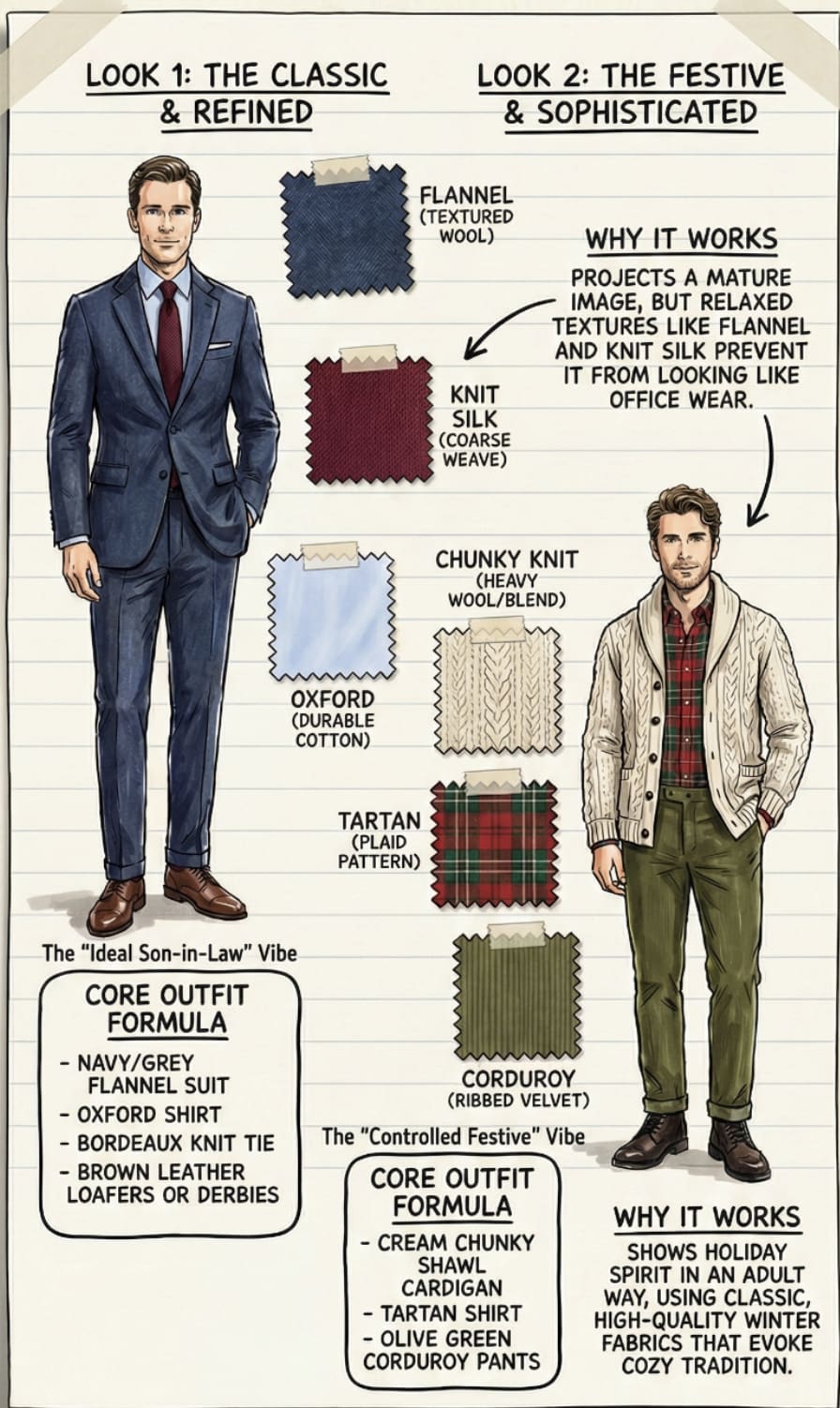
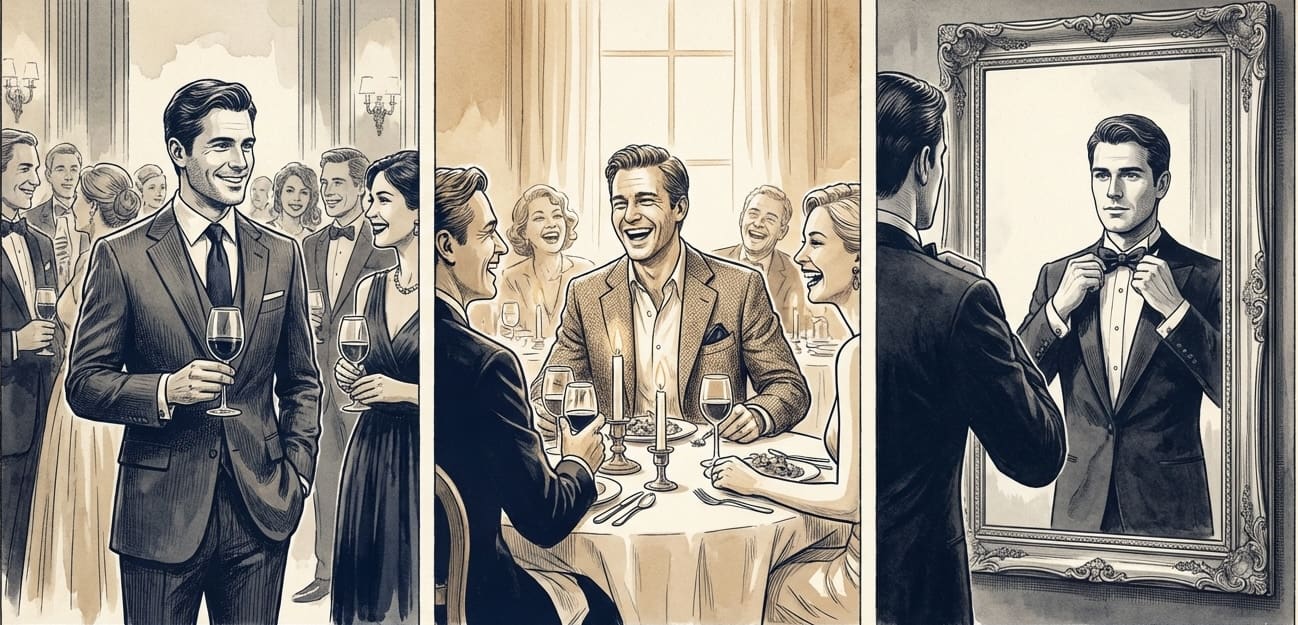
No more guessing games. Pick a scenario. Copy the board. The first visual guide that turns dress code anxiety into immediate execution.
The holidays are a sartorial minefield. Too dressed up? People ask if you're the waiter. Underdressed? You disrespect your hosts. This guide is not a fashion book. It is an instant decision tool based on 50+ illustrated boards for every thermal and social scenario.
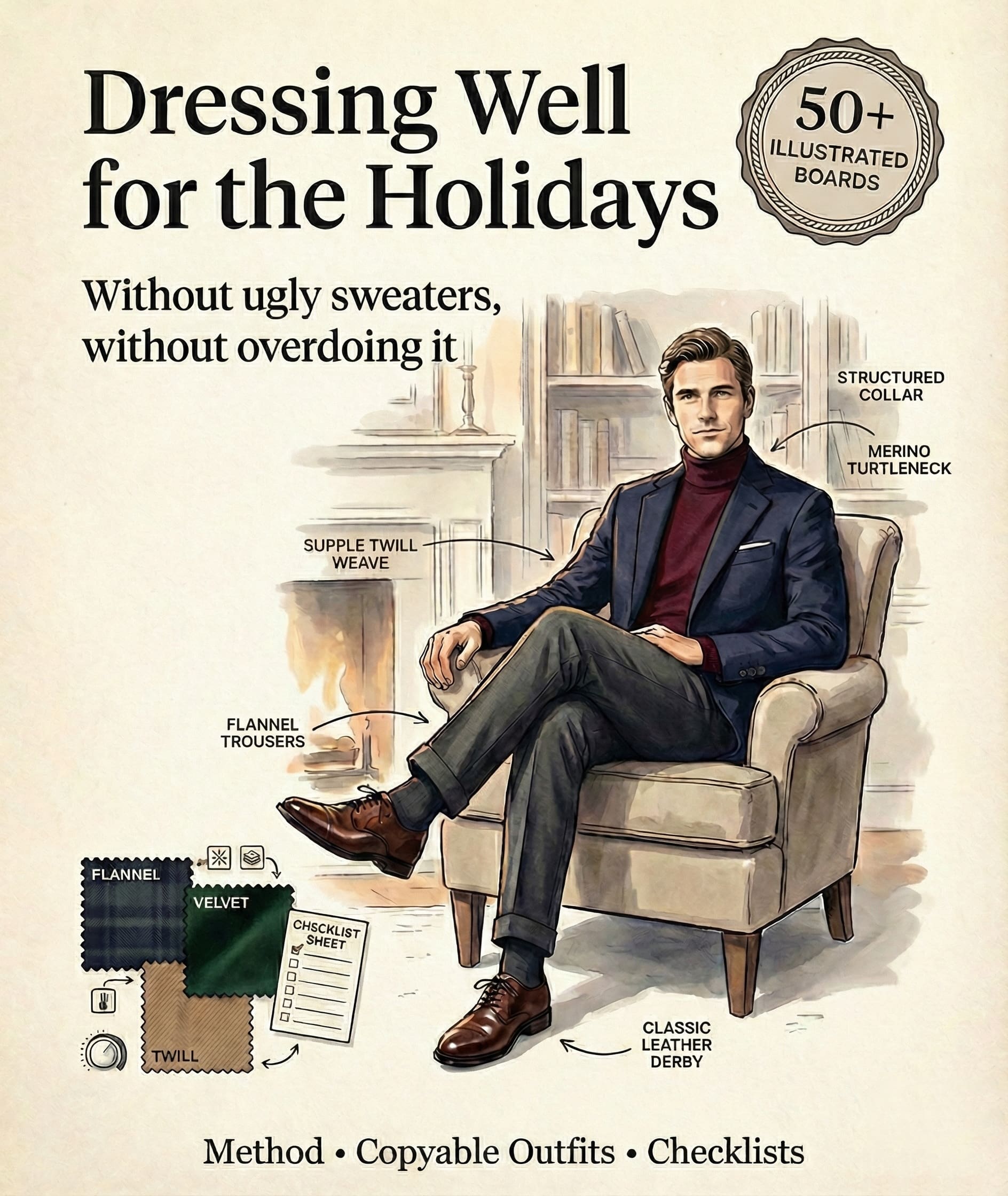
"No more guessing games. Pick a scenario. Copy the board. The first visual guide that turns dress code anxiety into immediate execution."
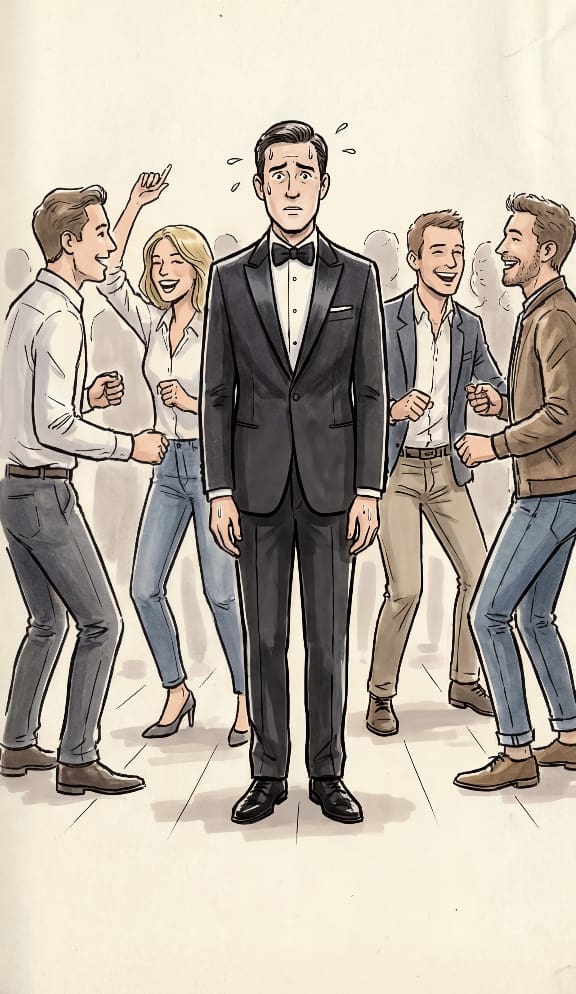
A few years ago, I went to a New Year's Eve party "among friends" in a sweltering Parisian apartment. I brought out the heavy artillery: worsted wool three-piece suit, heavy silk tie, brand new shoes. On paper, it was "elegant." In reality, it was a disaster.
As soon as I walked in, I knew. Everyone else was in crew neck sweaters, unstructured blazers, flannel chinos. I was the only one in full armor. I spent the evening sweating (the synthetic canvas of the time didn't help) and feeling the awkward glances. People didn't talk to me like a friend, but like a traveling salesman at the end of his shift. I was "overdressed." I had broken social harmony.
It was there, watching an Italian guest look impeccably comfortable in simple corduroy trousers and a fine knit, that I understood. Elegance isn't about wearing the most expensive garment. It is about thermal and social accuracy.
I spent the following months analyzing what I now call the "7 Social Thermostats." I dissected the weights of Biella drapers (VBC, Reda), studied fabric breathability for crowded interiors, and most importantly, I mapped every level of formality: from dinner at the traditional in-laws to the corporate cocktail party where a tie is a calculated risk.
This guide is the result of that obsession. It doesn't just teach you how to dress. It teaches you to read the room in 30 seconds so that your outfit is an obvious choice, never a costume. You won't need to think: look at the scenario, apply the board.
Uncertainty leads to error. And during the holidays, the error is etched into family photos for the next ten years.
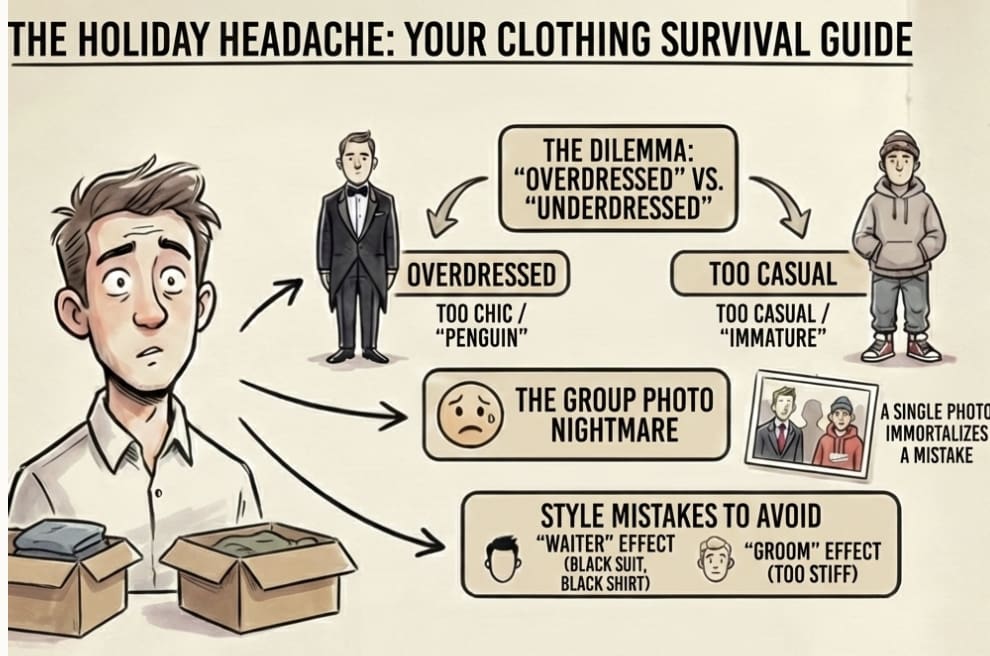
You think you're doing well with a black suit and white shirt. The result? Someone asks you for a glass of champagne. Black is a color for ceremony or service, not for partying (except in a Tuxedo).
Interiors are overheated. Your cheap synthetic suit will turn into a sauna by the aperitif. Sweat stains, red face, total discomfort. Elegance is primarily thermoregulation.
Arriving in a tuxedo when everyone is wearing ugly Christmas sweaters isn't a sign of taste, it's a failure of social intelligence. You make your hosts uncomfortable. You are "the guy trying too hard."
Unlike a random office day, the holidays are photographed. Your shirt collar curling up or your pants being too long will be immortalized on the family WhatsApp group. Forever.
"Elegance is not about being noticed, it's about being remembered. — Giorgio Armani"
"Cheap black fabric turns greenish under artificial light: always prioritize midnight blue or charcoal grey."
This is the rule of modulation. Keeping the tie looks like a "salesman who hasn't finished his day." Jeans are too casual. The mastered in-between (the spezzato or the styled no-tie look) is the key.
We are not talking about "fashion," but about textile and social engineering.
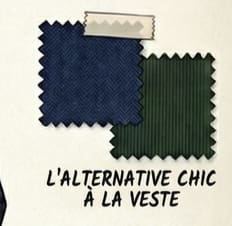
Why wool flannel (340g+) absorbs light and makes you photogenic, unlike fine office twill that shines under flash photography.
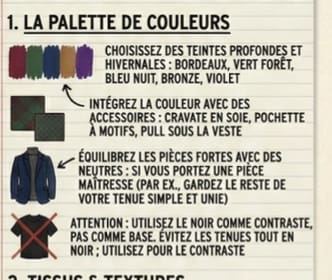
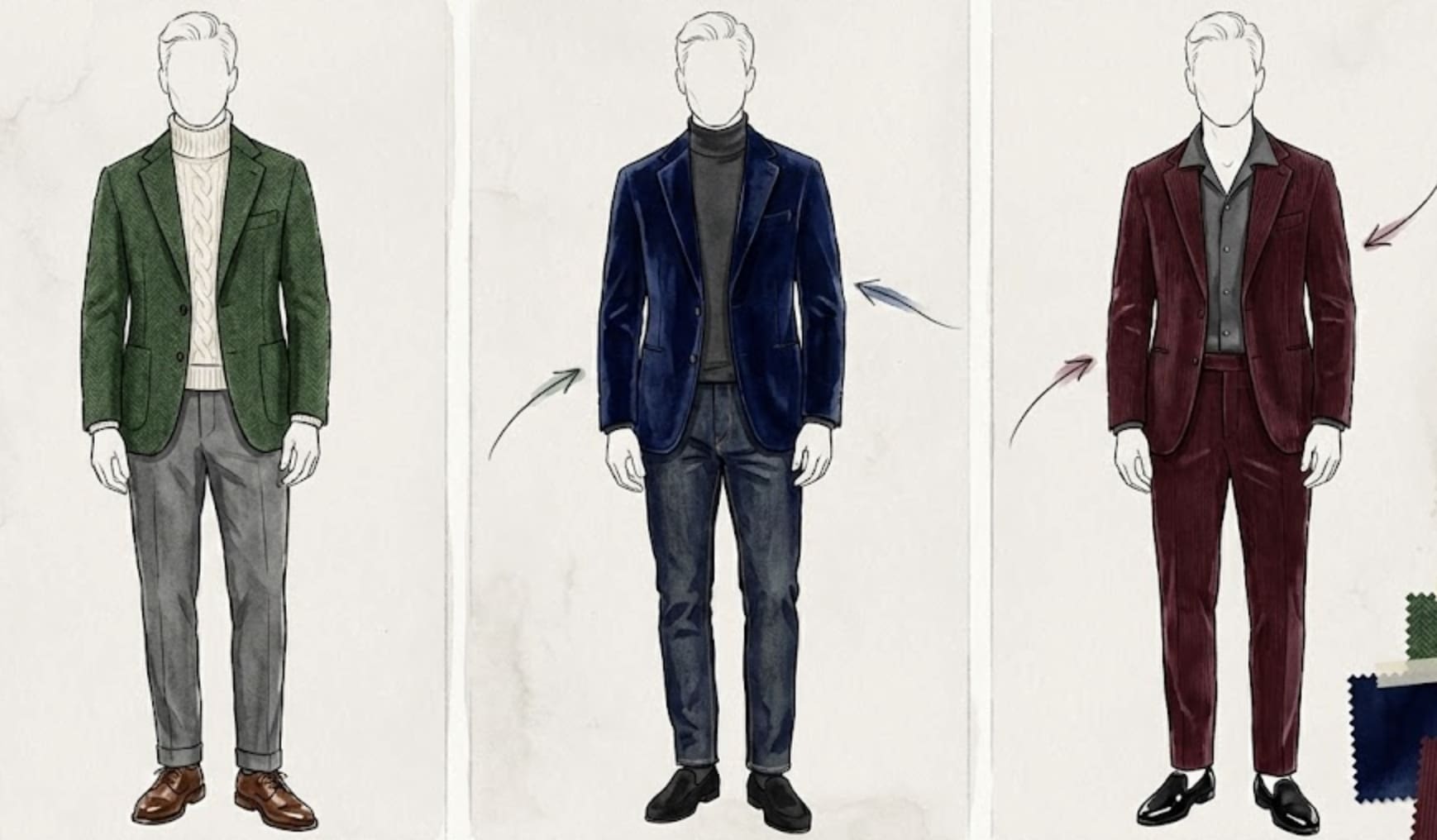
The strategic use of winter hues (burgundy, forest green, midnight blue) to step out of banking grey without falling into a Christmas tree costume.
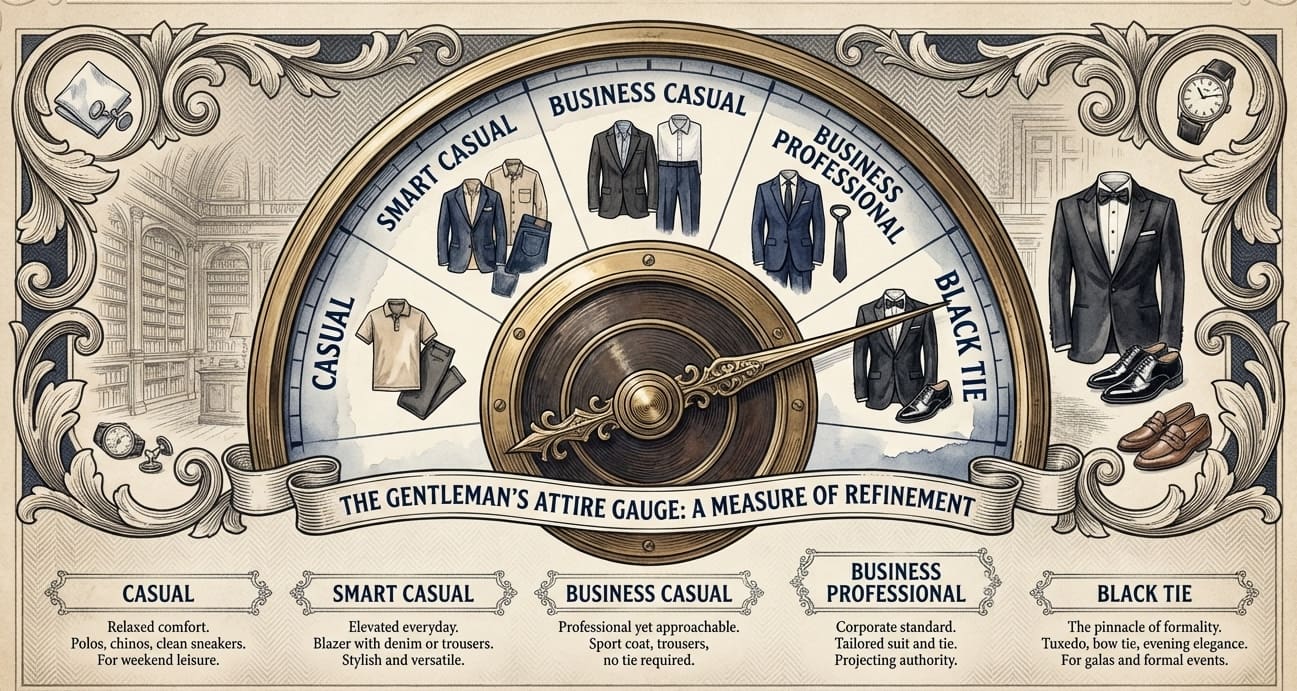
A decision algorithm that crosses location, guests, and time to give you the exact required formality (from 1/10 to 10/10).
No more abstract theory. Visual boards. You see, you apply.
Des illustrations techniques pour ne plus jamais commettre d'impair.
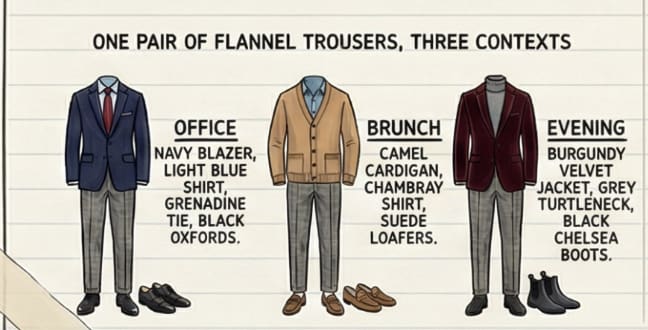
The 30-second rule to scan a room and know if you should take off your jacket.
Why your new shoes are your worst enemies on New Year's Eve (and the secret protocol to "break them in" in 1 hour).
The two-finger test: the only way to know if your shirt collar will let you breathe after the meal.
Corporate Cocktail: the subtle trick to switch from "employee" mode to "charismatic guest" mode without changing your suit.
Traditional In-Laws: how corduroy can save your reputation with your father-in-law.
The "pre-tied bow tie" mistake: why it's the detail that ruins a €1000 tuxedo.
How to manage the Indoor (22°C) / Outdoor (0°C) transition without looking like a giant onion.
Why "Black Tie" isn't just a black suit (and the 3 tolerated alternatives if you don't own a tuxedo).
The list of 12 "Holiday Capsule" pieces that can be reused all year round (make your purchase profitable).
Socks: the danger zone. When to dare a pattern and when to stick to solid Lisle cotton.
The "Casual Chic" trap: definitive decoding of the most treacherous expression on invitations.
How to accessorize without looking like a Christmas tree (the rule of subtraction).
The secret of fabrics that don't wrinkle, even after 4 hours sitting at the table.
Why your white office shirt is probably too transparent for the evening (and what to replace it with).
The "Spezzato" technique for parties with friends: the art of mismatching to dominate.
"If you must remove your jacket, make sure your suspenders or belt are impeccable. The devil is in the details."
Every situation is treated like a tactical mission. Objective: zero errors.
The precarious balance between professional credibility and festive relaxation.
Respecting traditional codes without appearing rigid or stuck-up.
From the Michelin-starred restaurant to the apartment party: never be off-topic.
"The price of this guide is less than a round of drinks or dry cleaning for a stained shirt. It's a tiny investment for total peace of mind."
Immediate access to the full PDF + mobile boards + checklist + THE 2 FREE APPENDICES (for the first 75).
💡 GARANTIE Satisfied or Refunded (if you don't find at least 3 applicable tips)
"At JamaisVulgaire, we campaign for rational elegance. No snobbish baseless rules, but a technical understanding of the garment and a social understanding of the context. This guide was designed to be read fast, understood instantly, and applied successfully. It is the condensed result of 10 years of sartorial expertise, purified of all useless fluff. Enjoy the holidays, we'll handle the style."
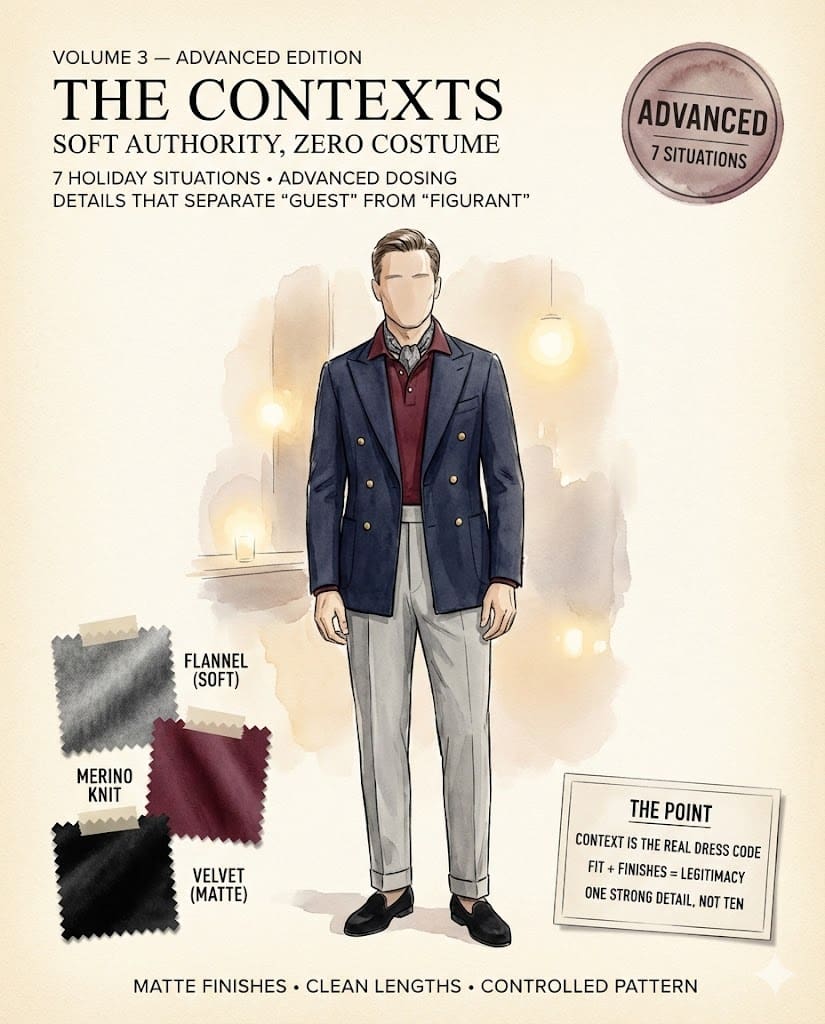
The 7 holiday situations decoded. Stop being the guy who made "zero mistakes" but whom nobody noticed. Learn to read the room, dose the intensity, and master textures.
You already know how to dress. Your wardrobe is healthy. The problem isn't the garment anymore; it's the moment. This manual is the bridge from looking "fine" to looking "inevitable." No more "penguin effect" on New Year's Eve or the awkward mismatch at after-work drinks. This is the art of sartorial dosage.
"The 7 holiday situations decoded. Stop being the guy who made "zero mistakes" but whom nobody noticed. Learn to read the room, dose the intensity, and master textures."
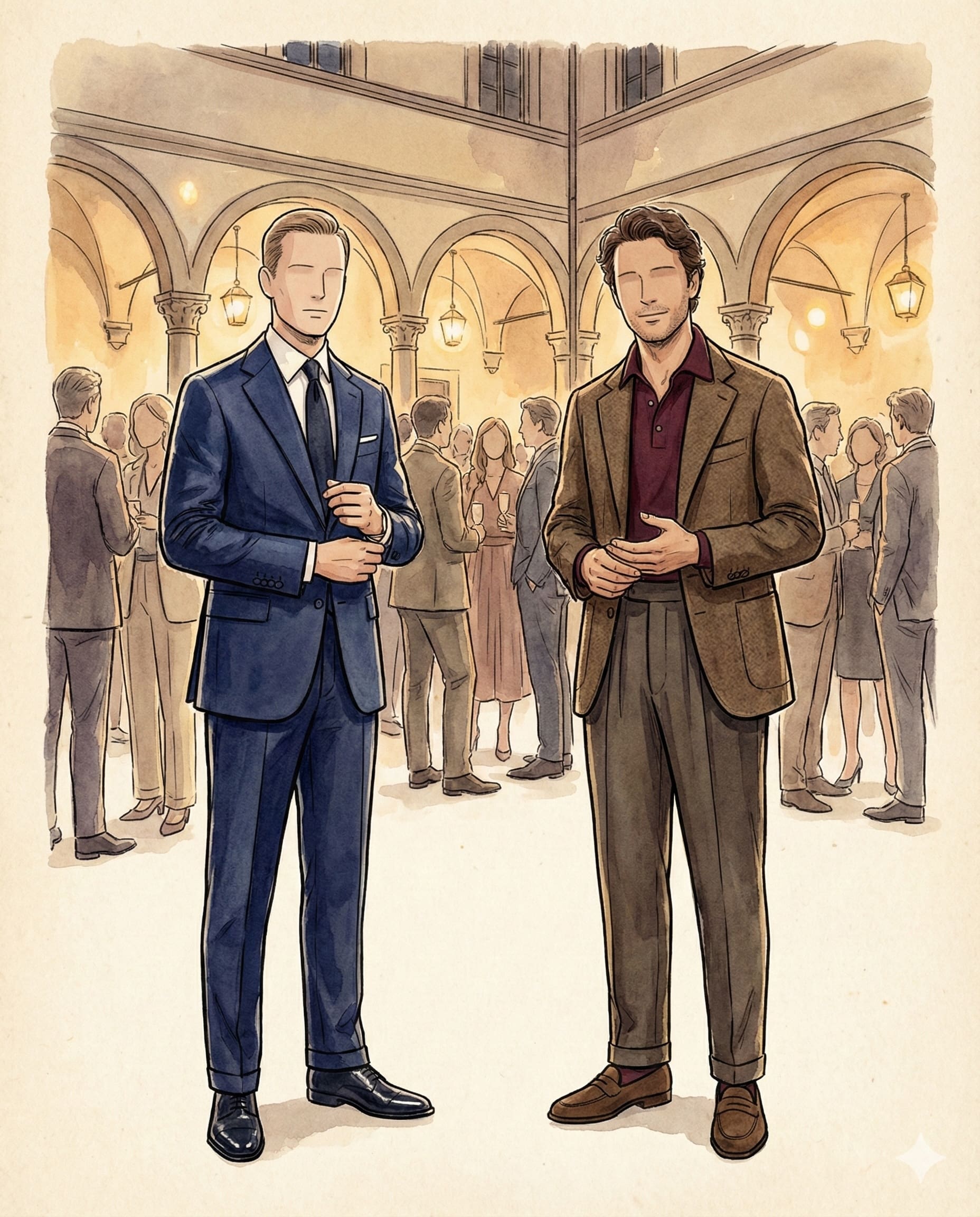
I remember an evening at Pitti Uomo, that Florentine temple of sartorial art. Amidst the crowd, two types of men stood out. On one side, the "scholars." They got everything right: the correct sleeve length, the proper trouser break, the matching tie shade. They were technically perfect. And yet, they looked like extras. They were forgotten the moment you looked away.
On the other side, there were those who seared themselves onto your retina. It wasn't a question of price, nor logos. It was a question of relevance. They didn't wear a suit like rigid armor, but like a second skin adapted to the specific moment. They understood that a family dinner doesn't require the same "armor" as a corporate cocktail or a club night.
That's when I realized that most style guides stop exactly where the real work begins. They teach you to avoid mistakes, but not how to create emotion. This Volume 3 is not a clothing catalog. It is a treatise on social strategy. It was born of a frustration: seeing men of taste ruin a beautiful outfit simply because it was played at the wrong volume, in the wrong room.
I have dissected the 7 classic scenes of the holiday season to extract the very essence: fabrics that absorb artificial light, cuts that allow you to digest with dignity, and the invisible details that signal to other connoisseurs that you are part of the club. This isn't fashion; it's non-verbal communication.
It's frustrating: you invested in nice pieces, but in photos, something is off. You don't look 'natural.'
You wear a dark suit and white shirt for New Year's, but the fabric is smooth and shiny. Result: someone asks you for a glass of champagne. You were missing texture.
You wore your beautiful heavy flannel suit to a dinner in an overheated apartment. You're sweating, you're red, you are enduring your elegance instead of living it.
You attempt the double-breasted blazer, but the shoulders are too wide and the trousers too long. You don't look like a gentleman, but like a child raiding his father's closet.
Your outfit is 'correct.' No bad taste. But it's flat. No relief, no material that catches the light, no point of view. You are well-dressed, but boring.
"Elegance isn't about wearing a suit, it's about knowing why you're wearing it."
"The Neapolitan 'Spalla Camicia': why a shoulder without padding changes your posture."
With sleek footwear like patent loafers or slippers, the trousers must never break. They must fall cleanly. Pant legs that bunch up ruin the verticality of the tuxedo.
Why texture beats the logo every single time.
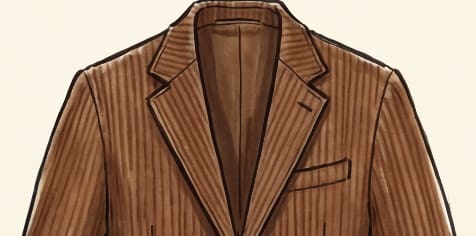
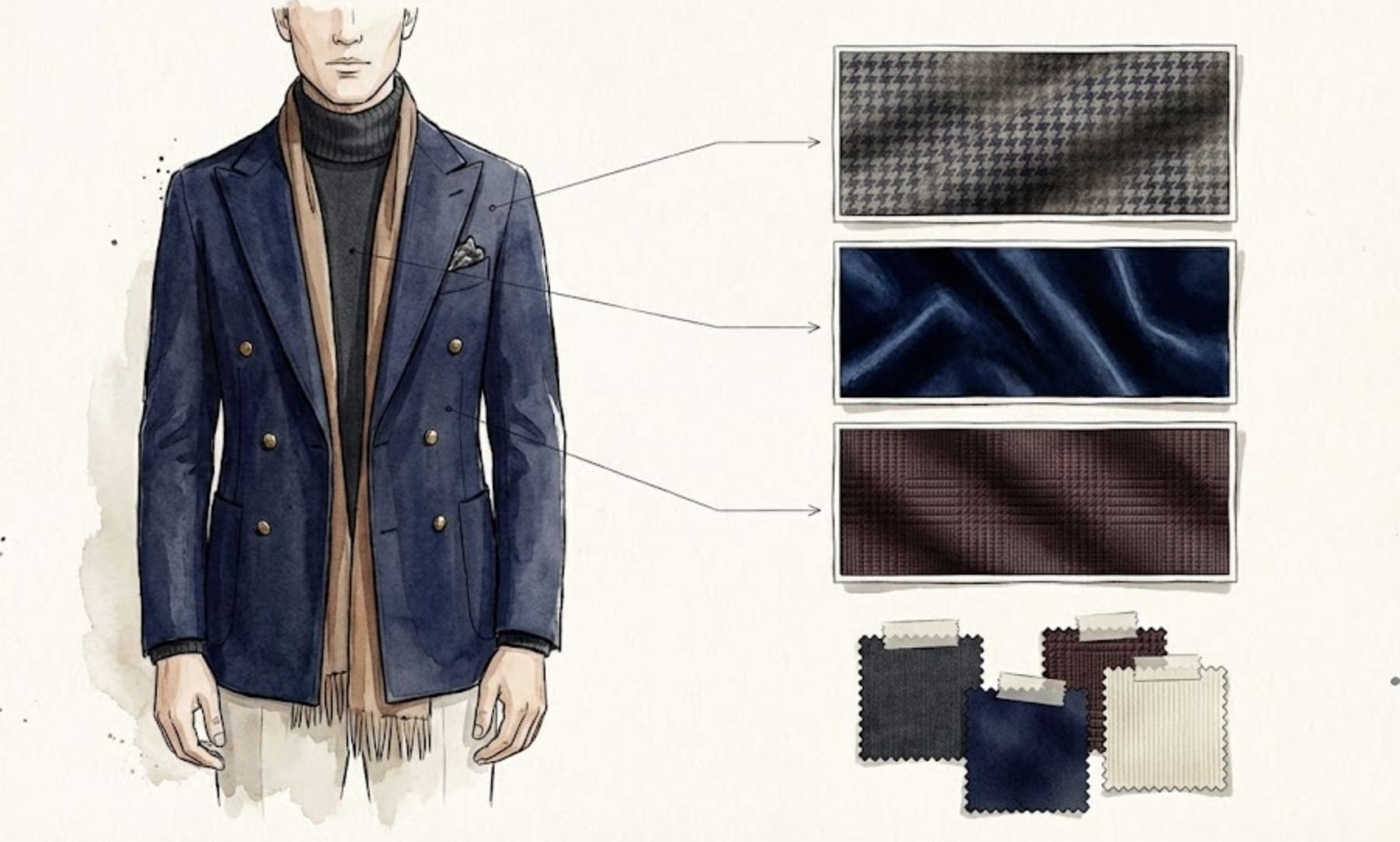
Office worsted wool reflects light flatly. Corduroy, with its ridges and relief, absorbs light and creates depth. It is the difference between a uniform and an outfit with character.
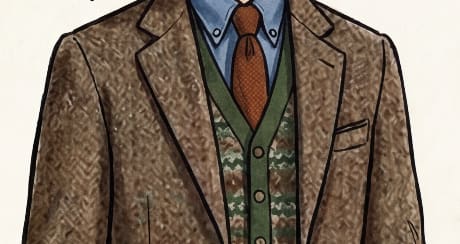
This speckled Irish weave is a social marvel. Its rough aspect invites touch and breaks the ice. It is the 'friendly' fabric par excellence, unlike the austerity of navy serge.
Density is key. A 4-ply cashmere sweater has a heavy, luxurious drape. Moleskin, a sheared and dense cotton, offers a hand similar to suede. These materials structure your silhouette without the need for artificial shoulder pads.
This is not a fashion ebook. It is an operational guide. For every social situation, I give you the battle plan, the alternatives, and the technical traps.
Des illustrations techniques pour ne plus jamais commettre d'impair.
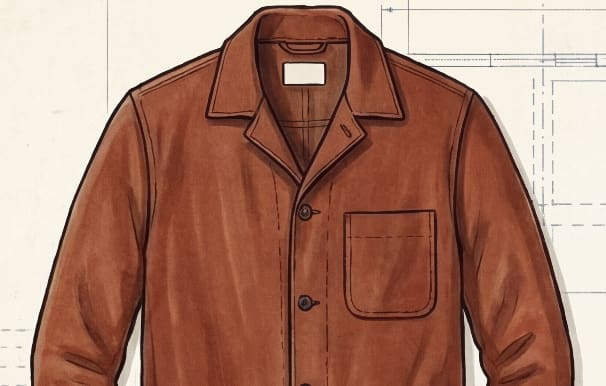
Why the 'Painter's Suit' is the secret weapon for after-work drinks (and why it absolutely must not have shoulder pads).
The tie alternative that saves short necks and enhances the face during a high-society dinner.
How to wear Donegal Tweed with family without looking like a retired geography professor.
The '4-ply' rule: why your current sweaters make you look sloppy after two hours.
The secret of midnight blue velvet: how it absorbs artificial light to make you more photogenic.
Why a turtleneck under a tuxedo is a risk... and how to pull it off without sweating.
The 'Winter White' technique: daring to wear light trousers in winter to distinguish yourself from the dark masses.
Recognizing real Selvedge denim at a glance (the red line detail).
The 'Stealth Wealth' in a nightclub: why the Valstar jacket definitely buries the nylon bomber.
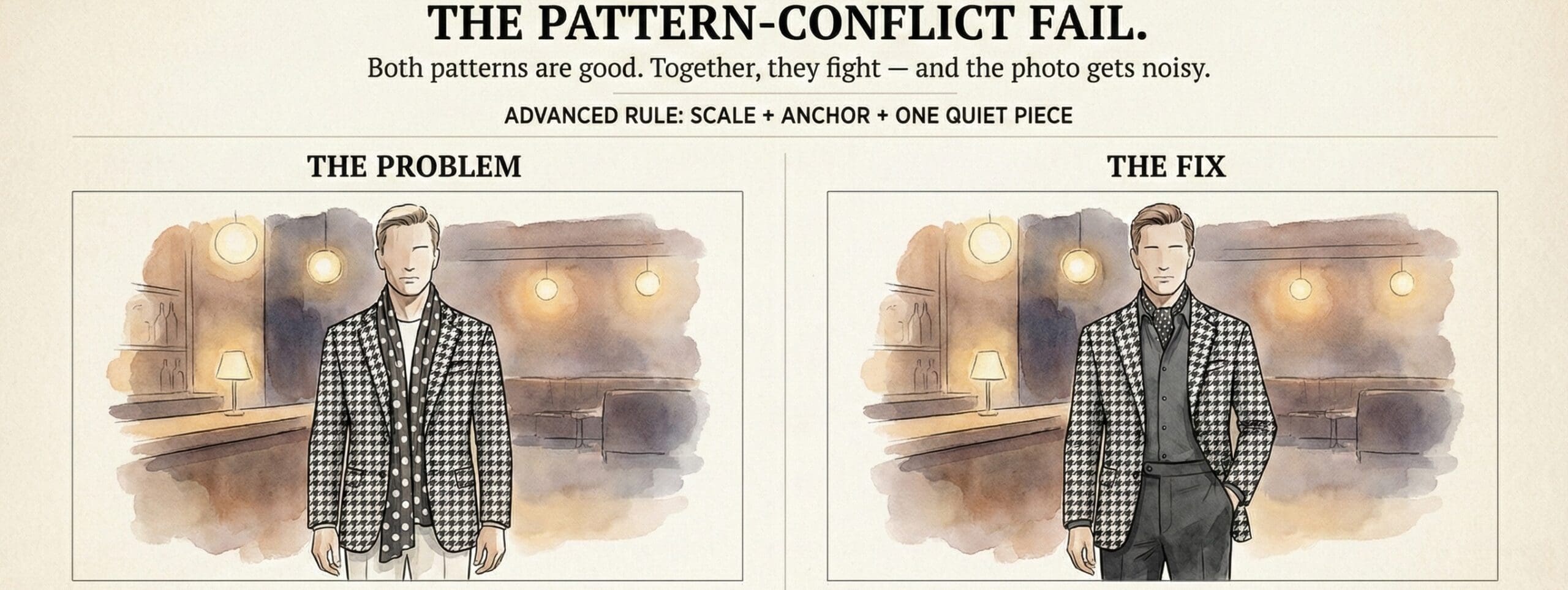
Mixing patterns like a pro: dots and houndstooth, the scale rule you must imperatively respect.
The art of the ironic 'Ugly Sweater': how to wear it with a Polo Coat to look like a style genius.
Sartorial cosmetics for the day after the party: how ecru and linen erase your dark circles better than cream.
Why you must banish the Windsor knot with a pin collar (and which knot to tie instead).
The 'nap direction' detail on a velvet jacket that proves its quality.
How to transform a work outfit into evening wear just by changing socks and a scarf.
"The 'Jigger Button': that vital hidden button that holds a double-breasted jacket together."
Each chapter dissects a real situation with surgical precision.
'Creative Director' vs 'Art Dealer' look. Mastered high-low.
Between respect for elders and digestive comfort. Tweed and Cardigans.
Revisited Black Tie or Power Suit. Time to shine.
Ivy League elegance or refined Workwear. Shoes come off.
Seducing in the dim light. Stealth Wealth and graphic patterns.
How to participate in the joke while remaining the most elegant man in the room.
Recovery Mode. Masking fatigue with light.
"You are not buying pages; you are buying the tailor's eye and the experience of hundreds of failed fittings that you won't have to endure."
The price of a gourmet coffee to avoid buying the wrong €500 suit.
💡 GARANTIE Satisfaction or Refund: If you don't find at least one tip that changes your vision of clothing.
"Masculine elegance is a language. If you only know three words, you will never be able to write poetry. This volume gives you the advanced vocabulary to express who you are, without saying a word. Invest in textures, not in logos. The rest will follow."
When layers disappear, details decide.
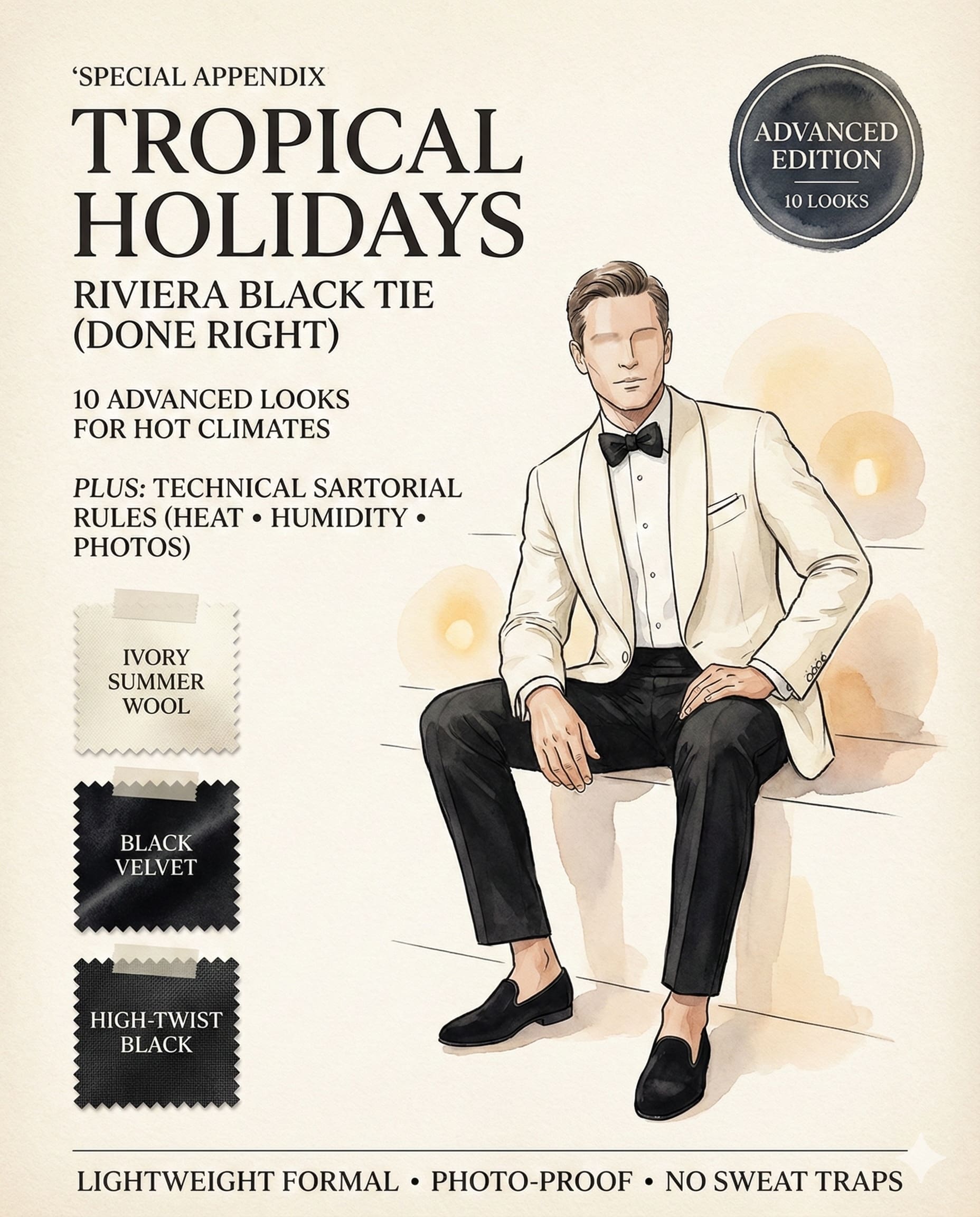
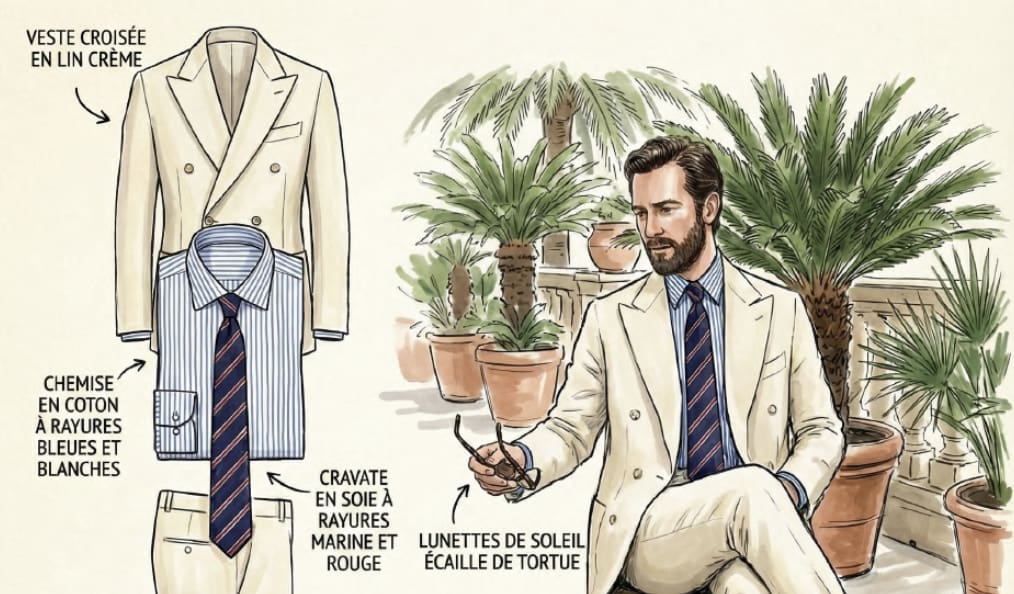
Elegance in a tropical climate is a minimalist problem with zero margin for error. Discover how to structure an adult, festive, and intentional outfit without sweating, without shining, and without looking like a tourist in costume.
"When layers disappear, details decide."
It is 2 PM in the central square of the Fortezza da Basso, in Florence. It is Pitti Uomo. The heat is crushing, a heavy humidity that instantly pastes your shirt to your back. Yet, amidst this open-air oven, I observe a fascinating phenomenon: certain men, often the older ones, draped in full suits, seem immune to the temperature.
A few meters away, tourists in t-shirts and synthetic shorts are dripping wet. The paradox is total. How can one be cooler in a suit than in beachwear? The answer lies not in magic, but in the physics of fabrics and the architecture of the garment. I spent the afternoon discussing with drapers from Biella present on site. Their verdict was final: the enemy is not the wool, nor the jacket.
The enemy is the construction. That day, I understood that tropical elegance is not built by the absence of clothing, but by the mastery of air. It is a science of subtraction: removing the lining, ventilating the weave, freeing the collar. This appendix is the compilation of these technical secrets, applied to end-of-year festivities in the tropics, where style errors are unforgiving.
In winter, you can cheat with layers. In the tropics, you are naked before your fabric choices.
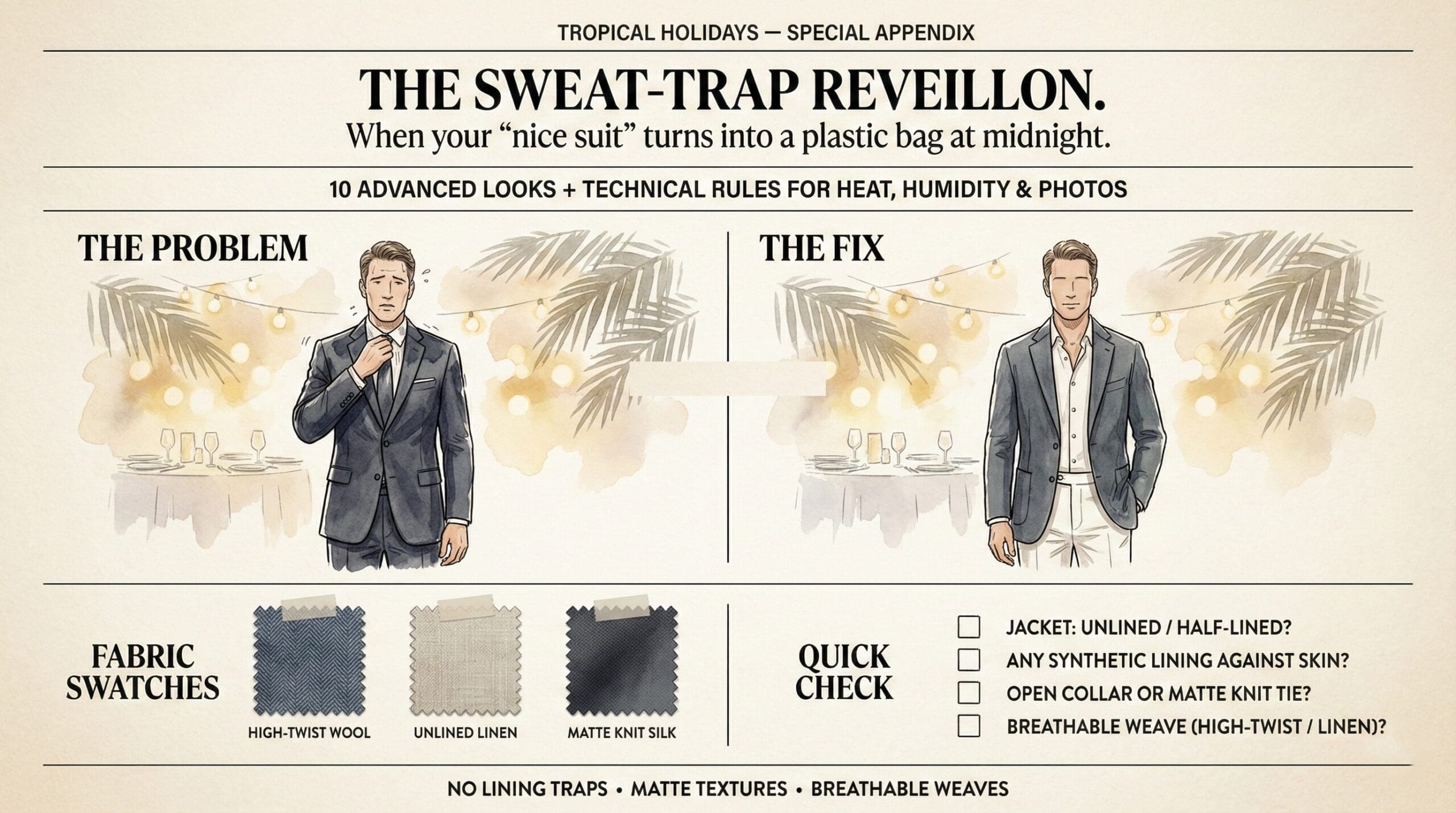
You buy a 'light' summer jacket, but end up soaking wet after 10 minutes. The cause? An invisible synthetic lining acting like a raincoat inside your refined suit.
You want to look dressed up, so you wear a dazzling white shirt. Result: in evening photos, you glow like a neon light, and in reality, it looks more 'phone plan salesman' than 'dandy on vacation'.
Smooth silk, satin ties, patent leather... Under strong tropical light, anything that shines looks 'cheap'. Tropical elegance must be matte, textured, and light-absorbing.
Out of fear of getting hot, you reduce the outfit to 'shirt + pants'. Without texture or a strong cut, you look like everyone else. The visual boredom is total.
"Summer is not an excuse for sloppiness; it is a challenge for craftsmanship."
"The Breath Test: Place your jacket fabric against your mouth and blow. If the air does not pass through instantly to the other side, you will suffocate."
It is the lining. An ultra-breathable linen jacket lined with cheap polyester loses all its thermal properties. It becomes a furnace. Always prioritize 'unlined' or 'half-lined'.
What the labels don't tell you.
Contrary to popular belief, heavy Irish linen (300g+) is superior for elegance. It wrinkles with roundness ('drape') whereas fine Italian linen breaks like paper ('crisp') and sticks to the skin.
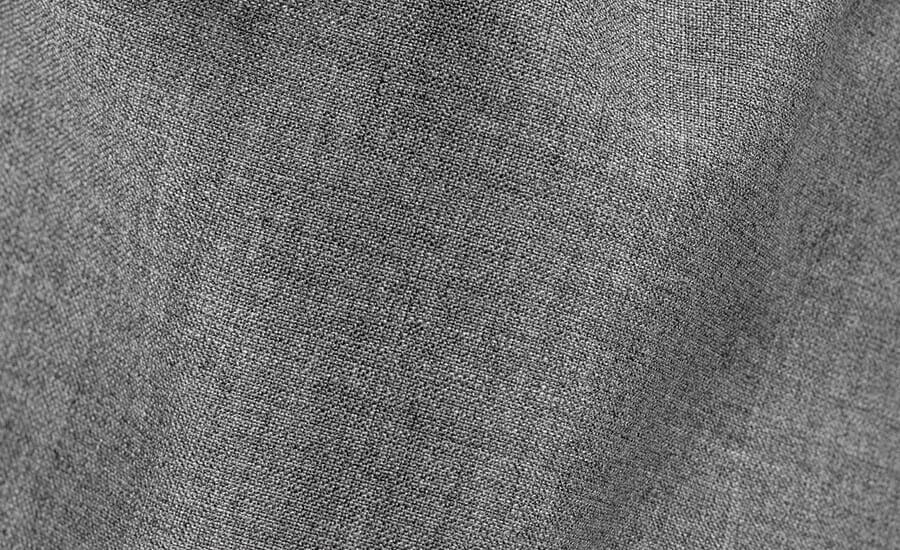
This 'High Twist' fabric is woven with over-twisted yarns. The result is a very open mesh, quasi-tearproof and wrinkle-resistant, which lets the slightest breeze pass through. It is the sartorialist's natural air conditioning.
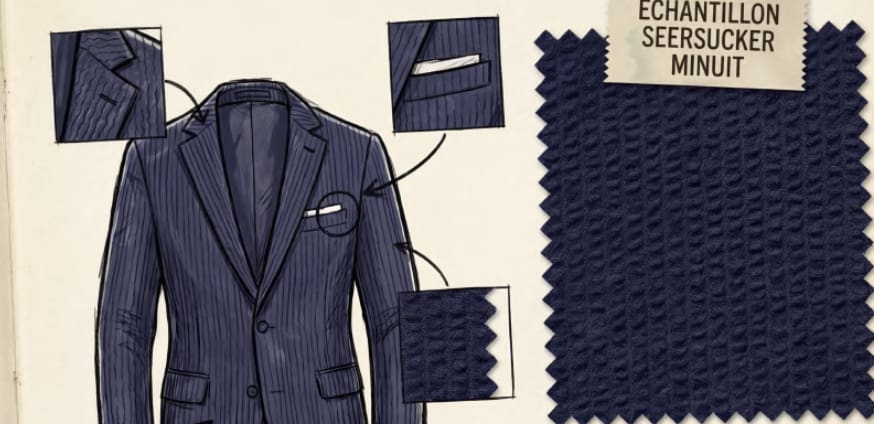
Forget the ice cream seller stripes. Modern seersucker is worn tone-on-tone (navy on navy). Its puckering creates air channels between the fabric and the skin.
This is not a fashion magazine. It is an operational manual of 10 broken-down outfits, with their accessible alternatives and immutable sartorial rules to stay dignified in 30-degree heat.
Des illustrations techniques pour ne plus jamais commettre d'impair.
Why your jacket lining is more important than the brand (and how to check it in 2 seconds).
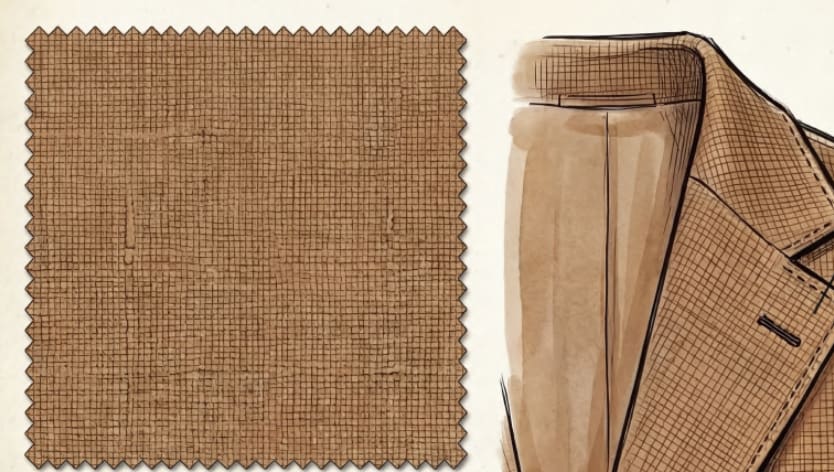
The 'Tobacco' color: why this specific shade buries beige and navy blue in the tropics.
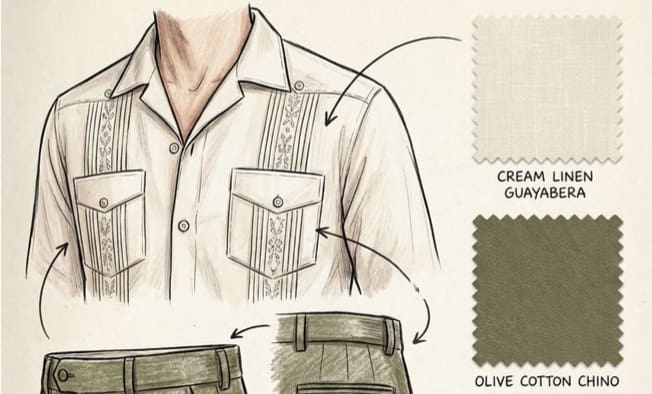
The secret of the Cuban collar: how to wear it over a jacket without looking like a B-movie gangster.
The Tropical Tuxedo illusion: how to compose a valid Black Tie outfit without owning a tuxedo.
Why optic white 'burns' your vacation photos and which nuance to prioritize to look wealthy.
The 'Air Tie' technique to remain formal without strangling yourself with a tie.
The 'Fresco' fabric: the only wool that allows you to step off the plane without a single wrinkle.
Madras, Seersucker, Linen: the hierarchical guide of textures to communicate your level of formalism.
Why you should wear velvet in summer (yes, but only on your feet).
The fatal error of invisible socks that are visible (and how to correct it).
The Teba jacket: this little-known Spanish hybrid that replaces the blazer when it's too hot.
How to wear red and green at Christmas in the tropics without looking like an elf.
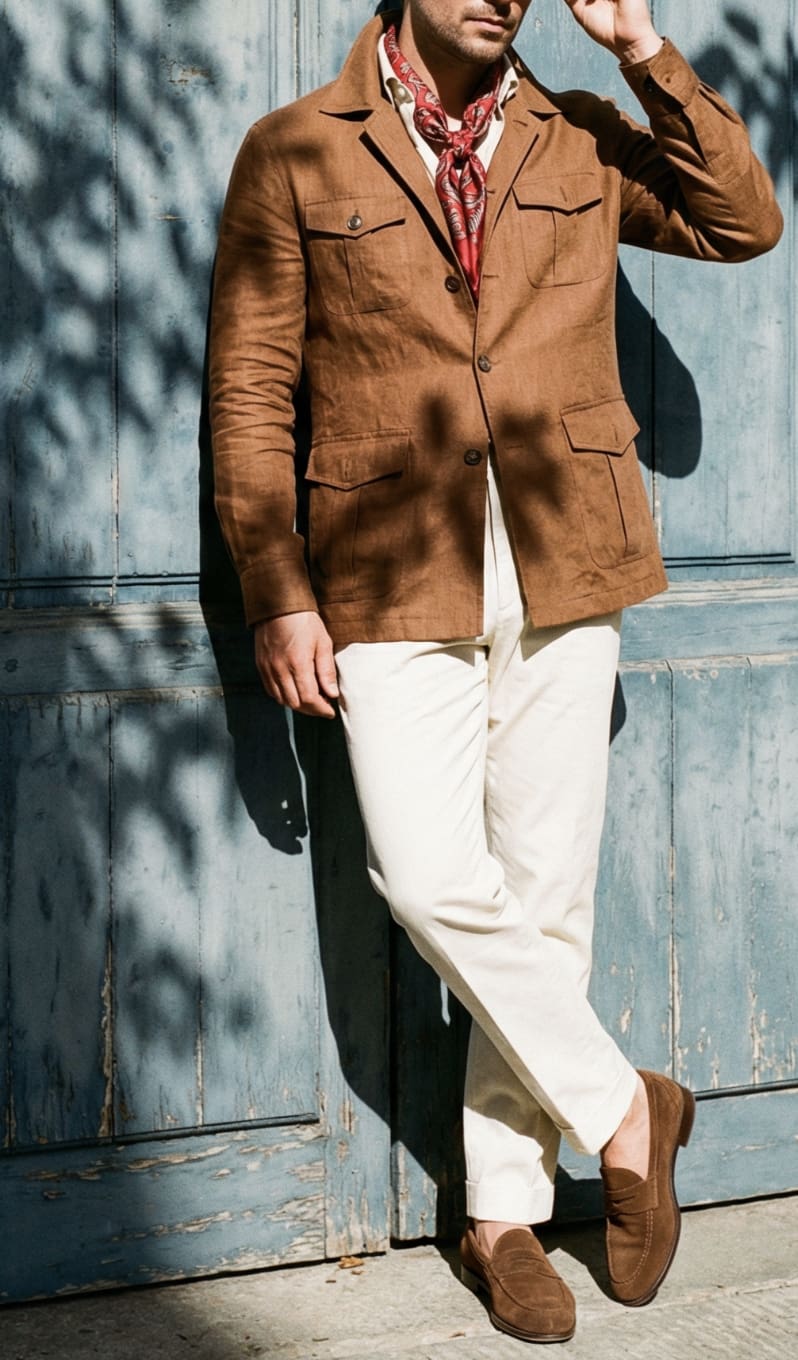
The detail point on the 'bellows' pockets of a real safari jacket.
Why heavy Irish linen is paradoxically cooler than fine Italian linen.
The Guayabera shirt trick to be as dressed up as in a suit, without a jacket.
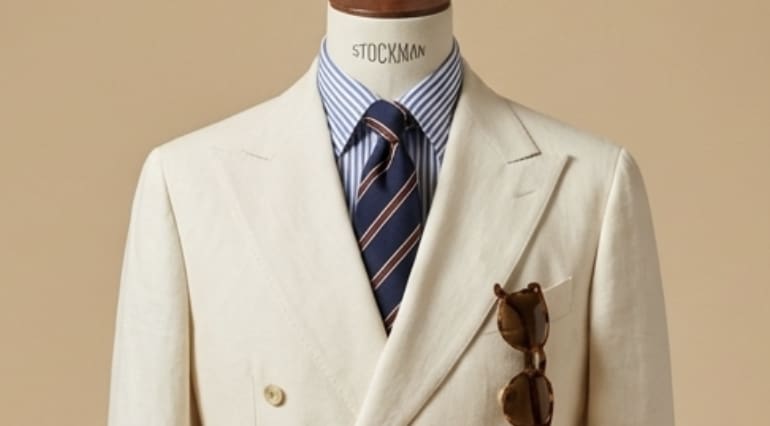
"The Ivory Rule: For flash photography at night, banish optic white which saturates the sensor. Ivory or ecru absorb light and render the complexion richer."
A clear structure for immediate results.
Casual elegance facing humid heat.
Marking tradition without suffering.
Glamour, Casablanca style.
"A single fabric error can ruin your comfort and your look in all your vacation photos. For the price of a cocktail, secure your image for years to come."
The complete manual + technical references + budget alternatives.
💡 GARANTIE Free for the first 75 registrants (Real value €7). First come, first served.
"We are tired of seeing male elegance collapse as soon as the thermometer exceeds 25 degrees. Style is not a question of temperature, but of knowledge. With this appendix, we wanted to prove that it is possible to remain dignified, structured, and refined, even in the heart of summer. It is a matter of respect: for oneself, and for one's hosts."